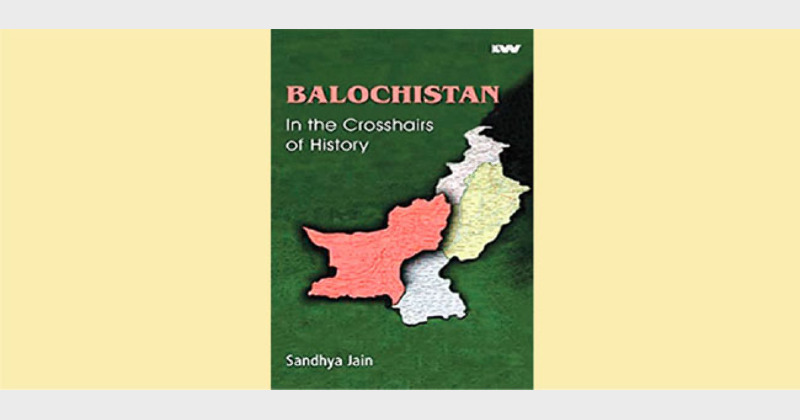
In six chapters, Sandhya Jain has succeeded in meticulously covering economic exploitation, peoples’ struggle, human rights violations and geo-strategic value of Balochistan. The author gives readers a complete understanding of the Baloch nation and its misery
–Rohit Srivastava
In the Crosshairs of History, Sandhya Jain,
Knowledge World, Delhi, pp 332, Rs 1560
Knowledge World, Delhi, pp 332, Rs 1560
The Indian subcontinent is a unique geography which hosts the world’s oldest continuous civilization but also the most exploited and brutalised people. It is ironic that on one hand its inhabitants have ensured the survival of its values and culture against all odds, on the other hand, they also betrayed their very own for petty benefits.
One of the most ignored parts of the subcontinent—politically, economically and historically—is Balochistan, the land of Baloch people. In 2016, Balochistan was reinstated in Indian consciousness when Prime Minister Narendra Modi during his Independence Day address mentioned the sufferings of the Balochs in Pakistan. The public discussion that followed exposed how little Indians know about the subject.
In her tenure as Senior Fellow, Nehru Memorial Museum and Library, Sandhya Jain tries to fill this knowledge void (“Balochistan: In the Crosshairs of History”, KW, 2021). Previously, in an edited volume on Jammu and Kashmir (“J&K: Invisible Faultlines”, Pentagon Press, 2019), she decimated the Nehruvian narrative by uncovering the hidden history of the State. From Jammu and Kashmir to Balochistan, Jain appears to be on a mission to uncover the ugly underbelly of the sub-continent’s historiography.
In six cogent chapters, the author covers the history, identity, peoples’ struggle, economic exploitation, and the geopolitics of Balochistan. In just 332 pages, the book succeeds in providing a complete understanding of the Baloch nation.
The historical land of the Baloch is today divided between Afghanistan, Iran and Pakistan. The geopolitical significance of Balochistan lies in its geo-location, from the mouth of the Strait of Hormuz to Sindh in the east, and north up to southern Afghanistan to Dera Ghazi Khan in the northeastern corner. This massive landmass connects three macro-regions: Asia, Africa and the Mediterranean basin. It forms the hinge between the Indian subcontinent, Central Asia and the Euro-Asiatic steppes and the Iranian plateau; between those regions which give on to—or gravitate towards—the Indian Ocean and its two Western “sea routes”, namely, the Persian Gulf and the Red Sea.
Balochistan’s wide Makran coast further connects the sea routes of East Asia, the Persian Gulf and the Red Sea. The province constitutes 44 per cent of Pakistan’s territory. This vast expanse of dry, arid, hilly land and full of mineral resources was strategically desired by contesting empire over centuries. Its current status derives from the colonial contest between Britain and Russia, with Persia (Iran) playing both sides and nibbling territory whenever it could.
The author explains the historical development of Baloch identity in detail, from their origins in Aleppo in northern Syria. Ethnically related to the Kurds, the Baloch diverged between 4th and 7th centuries to escape constant strife in the region and in search of pastures for their animals. Thus, the Kurds went to Iraq, Turkey and northern Persia; the Baloch to Persia and the southern Caspian region and further on. Over time, they settled across the coast of Bandar Abbas and Chah Bahar, to the coast of Karachi. They also settled in the southern part of present-day Afghanistan. Interestingly, the book notes the presence of an ethnic Baloch-speaking population in Turkmenistan. The book discusses the language, literature, religion, music and demography thoroughly, giving a complete account of Baloch culture.
Unsurprisingly, Balochi, the language of the Baloch, strongly resembles Kurdish language, Kurdgáli. As the people moved across West Asia, they picked up words from Persian, Dravidian, Urdu, Pashtu and other dialects. Though the two communities separated centuries ago, they share a tragic political destiny: both Balochs and Kurds meet the criteria of a nation—common ancestry, language, culture, and desire to live together—but lack their own country.
Balochistan has been inhabited by Balochs since the 7th century. They are mentioned in Ferdowsi’s Shahnamah as inhabitants of the northern Iranian plateau. Though mainly Hanafi Sunni Muslims, the Baloch revere the fourth Caliph Ali, father of Imam Hossein, whose followers formed Shia Islam.
During the medieval era, the Baloch managed to remain independent from the Safavid Persia and the Indian Mughal dynasty. This disconnected them from rest of the Muslim world. The colonial era intensified their isolation. Their plight was intensified when the British retreated from the region, denying the Kalat State (core of Balochistan) the independence guaranteed by the 1876 Treaty, and urging it to merge with Pakistan. Jinnah’s annexation of Kalat in 1948 was a natural climax to the dialogue begun by Viceroy Louis Mountbatten.
Jain discusses Kalat’s brief independence (August 4, 1947 to March 27, 1948) exhaustively. This is a very significant chapter as it explains the colonial perspective behind the Partition of India, the denial of independence to the Baloch, and their exploitation in Pakistan.
Balochistan’s geo-strategic value rose immensely between the First and Second World Wars on account of the discovery of oil in Saudi Arabia, Iraq and Iran. The Khan of Kalat and the emerging young nationalists could not understand the emerging geopolitical landscape and were outmanoeuvred by Louis Mountbatten and Mohammad Ali Jinnah. Their task was made easier by the Khan of Kalat’s personal admiration for Jinnah, whom he recruited to represent his case to the Cabinet Mission, and innocently funded the Muslim League, blissfully unaware that it would gobble up his kingdom and his dreams.
Kalat’s annexation was a painful saga of conspiracy, lies, and betrayal. After Narendra Singh Sarila’s “Shadow of the Great Game: The Untold Story of India’s Partition”, this is probably the best documentation of the lesser-known events leading to the Partition and the end of Kalat State. Jain’s use of Pakistani official sources, Jinnah Papers, brings the annexation alive.
Jain succinctly explains Russian expansion into Central Asia, Iran and Afghanistan, thus providing historical context to the events that are a prelude to the present and the future, as colonial constructs bedevil the lives of former colonies. London not only divided Balochs but also the Pashtuns who are still struggling with the curse of the Durand Line between Pakistan and Afghanistan.
The intermittent Baloch insurgencies against Pakistan make compelling reading, and include the now well-known saga of disappeared persons, targetted assassinations, and gross human rights violations. The Baloch struggle has intensified China building the China Pakistan Economic Corridor through their land, taking over the Gwadar port, and expropriating the Baloch while extracting their mineral resources.
(The writer is a Delhi-based journalist specialising in defence and strategic affairs)