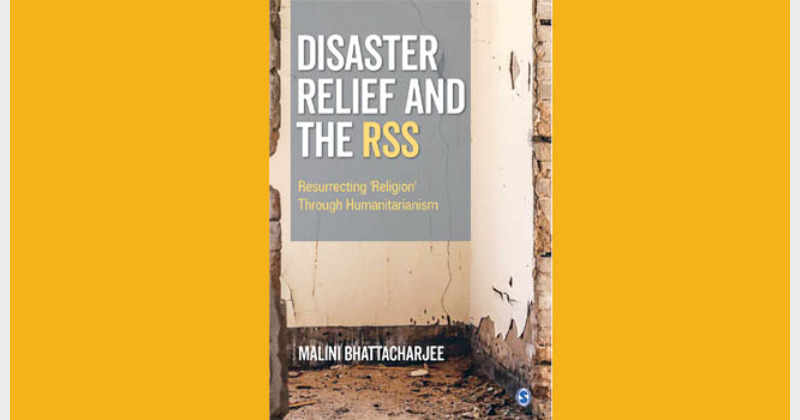

‘The RSS: Resurrecting ‘Religion’ through Humanitarianism’ —Malini Bhattacharjee Published by Sage Publications,
New Delhi, Pages: 268, Price: Rs 765
New Delhi, Pages: 268, Price: Rs 765
Throwing light on the service activities by RSS swayamsevaks, the book, ‘Disaster Relief and The RSS: Resurrecting ‘Religion’ through Humanitarianism’ by Malini Bhattacharjee, is indeed a new step towards creating a deeper academic understanding of the RSS and the political phenomenon that it has effected in contemporary Bharat
Swadesh Singh
Rashtriya Swayamsevak Sangh (RSS) is more than just an ideology, it is a methodology,” said RSS Sarsanghachalak Shri Mohan Bhagwat while addressing a three-day lecture series at Vigyan Bhavan in New Delhi in 2018. With the BJP emerging as the biggest political party of the country and resolutely occupying power in states and the Centre, the RSS itself has come under considerable spotlight. It can be safely said that RSS today is no longer an alternative discourse, it is, in fact, the main discourse of the country. With millions of ‘swayamsevaks’ involved in voluntary work across the country and overseas, it has also become the subject of curiosity, conjecture and myth.
Going back to the early years of RSS, Pt Jawaharlal Nehru had labelled the RSS as a communal organisation as early as in 1946. Nehru later ruled the country for 17 years and left behind a legacy of Nehruvian ideology, which talked about secular nationalism, non-alignment and Socialism. This Nehruvian ideology brought greater acceptance to the idea that RSS was a communal organisation. As a result, the RSS came to be seen within an insulated secular-communal framework and no need was felt to go beyond that understanding. No critical approach was developed or empirical studies were conducted on the works of the RSS other than in the pre-fixed context of secular-communal dualities. Barring the work of rare academics like Walter Anderson and Pralay Kanungo, no serious attempts were made to develop an understanding of the work and approach of the RSS based on academic enquiry and data. The subject was always approached with narrow pre-arrived conclusions on the ideas of RSS and Hindu Rashtra. The outcome was that RSS was labelled as a radical ‘Hindu Right-Wing’ organisation with ‘Fascist’ objectives and all views were restricted to this narrow typecast setting.
Against this backdrop, Malini Bhattacharjee’s book, ‘Disaster Relief and the RSS’, offers a new understanding of the work undertaken by the RSS over the past 90 years. The author, who holds a PhD from JNU and is currently an assistant professor at Azim Premji University, Bengaluru, focuses on the Sewa (service) aspect of the RSS—approaching it both from an academic standpoint to look at the broader picture and also the point of view of the organisation itself that considers it a duty to work for the society. Be it the refugee camps after Partition, or soldiers facing the ravages of war in 1962, natural calamities like Uttarkashi and Latur, mishaps like Charkhi Dadri or Sewa Bastis where RSS works for the downtrodden, marginalised and vulnerable with the philosophy of Antyodaya—away from the communal agenda so conveniently attributed to it, RSS has relentlessly pursued its humanitarian work that has gone largely undocumented and certainly unrecognised.
For the purpose of this book, Bhattacharjee uses Orissa cyclone and Gujarat earthquake as case studies to understand the Sewa aspect of the RSS. The first chapter locates disasters as a site where state and non-state actors come into play and brush shoulders to gain mileage out of relief work. This chapter provides an interesting history of disaster relief in India and points out the fast-eroding demarcation between ‘secular’ and ‘religious’ aid providers. While she indicates the essential politics behind normalising a pervasive secular-religious dichotomy, she also discusses what makes ‘politico-cultural’ organisations like the RSS unique, “…unlike the religious organizations, they neither practise any liturgical rituals nor adhere to any Church-like ecclesiastical order. However, it would also be erroneous to club them as ‘secular’ voluntary groups, as their modes of mobilisation are centred on the protection of ‘Hindu dharma’ with frequent allusions (no matter how superficial) to traditions, customs and rituals of the Hindu religion.”
The following two chapters analyse the concept of ‘Sewa’ and its practice in the RSS, respectively. The second chapter, which discusses Sewa and its multiple dimensions, is a particularly interesting read as it balances the study by bringing in an intrinsically Indian understanding of the term with all its complexities as against the idea and concepts around ‘gift making’ which entails necessary reciprocity. This chapter explores various forms of ‘daan’ and the evolution of the concept of Sewa from Bhakti period to Gandhi and later Hindu nationalism. Continuing this line of thought, the third chapter explores ‘nation-building’ through Sewa and RSS’s understanding and imagination of the term. In this context, the word Sewa is seen to acquire a spiritual dimension. Quoting Shyam Parande, coordinator of Sewa International, Bhattacharjee says, “He further mentions that Sewa is neither charity nor service and that ‘it goes way beyond that’. Parande explains that Hindus by birth incur four ‘runas’ (debts): Matru Runa—debt to one’s mother; Pitru Runa—debt to one’s father and your ancestors; Rishi Runa—debt to sages; and Samaj Runa—debt to one’s society. Sewa, he suggests, is the fulfilment of this last runa.”
Bhattacharjee stresses on analysing ‘Hindutva’ in contemporary times by identifying new forms and structures of society that are actively assimilating the ‘sacred’ within the ‘secular’
This chapter also highlights the non-sectarian quality of Sewa rendered by the RSS. For it Bhattacharjee cites Golwalkar’s letter to K. Suryanarayan Rao and an account of Charkhi-Dadri relief work by Dr Zafarul Islam Khan. These documents bring out the fact that the RSS idea of Sewa stems from essential service to the nation and makes no religious distinction. The following two chapters of the book provide a detailed overview of the relief and rehabilitation activities undertaken by RSS after the Super Cyclone in 1999 and the Bhuj earthquake in 2001.
The book essentially lays out three strands—humanitarianism, Sewa and political dividends. The segment on humanitarian lays out disaster sites and relief work as deeply political spaces where ‘sanctification and secularisation’ are so enmeshed that it is difficult to discern the difference between ‘secular’ and ‘religious’. The segment on Sewa traces the evolution of the concept and highlights the consistent strain of selflessness.
It is pertinent to point out here that RSS beliefs have been rooted in ‘prasiddhi parangmukhta’ or renunciation of fame. It is owing to this that the organisation has never tried to publicise its relief efforts even when such an activity could have certainly brought it to fan following and cadre enhancement. Moreover, Bhattacharjee restricts observations to the context of disaster relief while RSS’s humanitarian work goes far beyond that and does not carry any proselytisation baggage. Of course, goodwill towards RSS and enlisting for its cause are a natural outcome of its humanitarian efforts but these are not the outcomes that are either expected, expressed or implied by the organisation.
Nevertheless, Bhattacharjee steps into an entirely untouched domain with her work. She has undertaken interviews, fieldwork, study for the purpose of this book and the result is rewarding. She indicates a need to analyse ‘Hindutva’ in contemporary times by identifying new forms and structures of society “that are actively assimilating the ‘sacred’ within the ‘secular’”. The book is indeed a new step towards creating a deeper academic understanding of RSS and the political phenomenon that it has affected in contemporary India.
(The writer teaches Political Science at Satyawati College, University of Delhi)