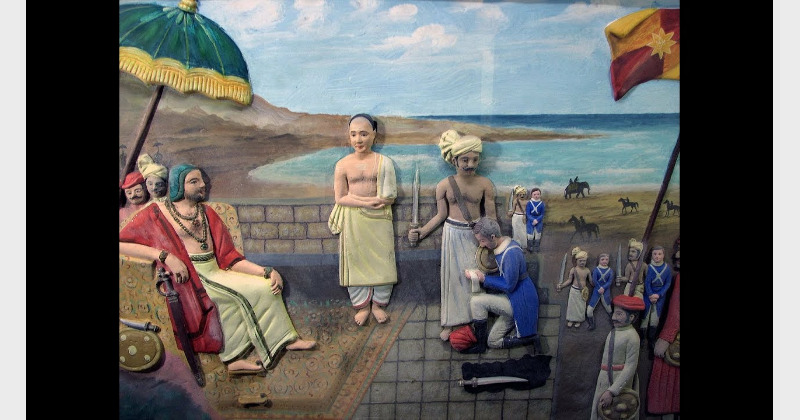
Eustachius De Lannoy’s surrendering before Maharaja Marthanda Varma at the Battle of Colachel
In 1741, Travancore scripted a glorious chapter in world history, becoming the first Asian Kingdom to defeat a European Colonial Power, when the formidable Travancore Nair Force of Maharaja Marthanda Varma categorically defeated the expansionist Dutch colonial force in the famous ‘Battle of Colachel’
In world history, Japan is credited with the title of the first Asian country winning over a European power. When we look back to our history, rather a western narrative of Indian history, it fills our heart with contempt, inferiority and disdain as glimpses of the timeline of our nation are replete with submissions, defeats and deceits. However, a critical examination of Indian history unfolds hitherto uncared for scrolls of golden epochs, among which ‘Battle of Colachel’ stands out for its greater significance that left an unforgettable mark of pride and bravery in the history but largely faded from collective memory.
In the southern strip of Bharat lies a small piece of land, the erstwhile Travancore kingdom, the southern part of present Kerala, that has marvelled us by promising countless ‘First in India’ achievements to our country’s record book.
Marthanda Varma ascended to the throne in 1729 as the king of Venad chiefdom (that later became Travancore), amidst furious internal feuds spearheaded by the powerful ‘Thampis and Ettuveettil Nairs’ (eight prominent Nair aristocratic families that wielded power during that time). Thampis (Sons of previous Maharaja) claimed the throne, challenging the ‘matriarchic system’ followed by Travancore Royal Family. As a result of the prolonged tussle with Ettuveettil Pillais, Marthanda Varma had to flee the palace as a fugitive for a short period. During that time, he survived several murder attempts. Eventually, sometimes with his strategic moves, at other times with brutal iron fists, King Marthanda Varma defeated all Nair aristocrats and power centres that challenged his existence.
In the words of the noted historian, Professor A. Sreedhara Menon, the Battle of Colachel was “A disaster of the first magnitude for the Dutch, the battle of Colachel shattered for all time their dream of the conquest of Kerala.”
Meanwhile, the northern part of Kerala, the Malabar region was almost engulfed by the Dutch colonial forces and was exploring ways to spread its clutches to Kochi and other southern parts to further advance its trade and imperialistic interests. Anticipating the danger, Marthanda Varma annexed neighbouring kingdoms like Elayadathu Swarupam, Kayamkulam that came under the spell of the Dutch, to Venad by means of strategic coercion and battles, and established a new dynasty known as Thiruvitamkoor aka Travancore. The expansionary policy of Marthanda Varma endangered the Dutch East India Company’s trade interests in the region since they feared that the British, who had already signed a treaty with Marthanda Varma, would gain the rights to the pepper trade in the Malabar coast.
As a response, Dutch Governor of Ceylon Gustaaf Willem van Imhoff wrote to Marthanda Varma demanding that he should end the aggression against Kayamkulam. Marthanda Varma wrote back to Van Imhoff, ordering him not to interfere in affairs of Travancore that did not concern the Dutch. In a subsequent meeting, Imhoff demanded that Marthanda Varma restore the annexed Kayamkulam to its former ruling princess, else he would be attacked. Marthanda Varma snubbed it with a witty comment, “Well, I was considering an invasion of Europe”!
Following the meeting, Dutch marines from Ceylon led by Captain Eustachius De Lannoy landed with artillery in Colachel to attack Travancore. The Dutch captured the territory up to Padmanabhapuram and laid siege to the Kalkulam (Padmanabhapuram) fort. Marthanda Varma and his Prime Minister Ramayyan Dalwa, who had been camping in Trivandrum, promptly marched south with the infantry, cavalry and artillery of the Nair force and prevented the capture of Kalkulam fort by the Dutch. Succumbing to the massive counter-attacks launched by the Travancore force, the Dutch were forced to retreat to their defensive positions in Kulachal.
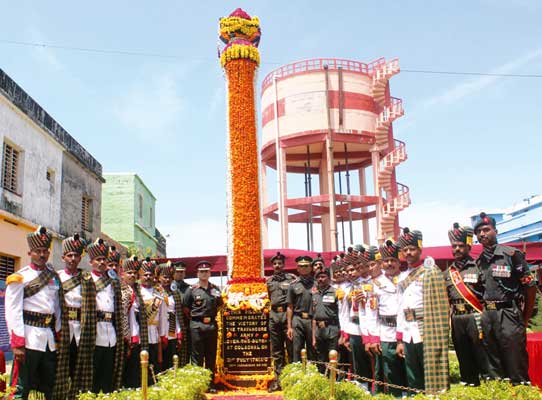 Victory pillar, in remembrance of victory against the Dutch Navy in 1741
The Dutch Naval force could not withstand the fierce counter-attacks unleashed by the Nair Army. The Nair force, under Commander-in-Chief Thanu Pillai, inflicted a massive loss to the Dutch, fleeing the battle scene, the Dutch ships sailed for Cochin, leaving behind 389 muskets and some artillery. The enemy surrendered before Maharaja Marthanda Varma on August 14, 1741. The history marks it as a decisive victory of Travancore over the Dutch, capturing a large number of Dutch soldiers; including 24 officers.
Among the captives were the Dutch Captain Eustachius De Lannoy and his second in command, Donadi. They were taken as prisoners. The strategist and visionary in Marthanda Varma offered him the post of Commander of Travancore Force, with an honorary title ‘Valiya Capithan’ bestowing upon him. His task was to train and modernise the Nair force, build up a permanent army under the state and equip them to face large-scale attacks. An interesting anecdote suggests, as the local Nair soldiers could not follow ‘Left-Right-Left’ during military drill, De Lannoy tied coconut leaf (Olakkal) in their left legs and a piece of cloth (Sheelakkal) in the right, and taught those who did not know how to say ‘left-right’ to say ‘olakkal–sheelakkal‘.
Under Marthanda Varma, Travancore flourished and made a strident growth in all spheres. He brought about several administrative reforms in the state. He reconstructed the Padmanabha Swamy temple which was mostly destroyed in a fire during his predecessor Rama Varma’s time. Moreover, Travancore emerged as an indomitable military power in southern India which later under the military commander Vaikom Padmanabha Pillai defeated Tipu Sultan. The Nair Force led by Veera Veluthambi Dalawa later fought against the British and inflicted a huge loss to the East India Company. As a result, the British categorised the Nair force as dangerous, and banned from the British Indian Army for a quite long time. The Travancore Nair Force, which was reorganised as the Travancore Nair Brigade in 1818, was later integrated into the Indian Army as the 9th Battalion Madras Regiment (1st Travancore) and the 16th Battalion of the Madras Regiment (2nd Travancore) in 1954, after the integration of the State into the Indian Union.
After twenty years of his rule, Marthanda Varma, in a historic decision (known as ‘Thrippadi Danam‘) that changed the fate of Travancore, surrendered his kingdom and all powers at the feet of God Maha Vishnu, Sri Padmanabha Swamy, (the deity of Padmanabha Swamy Temple, Trivandrum) the Kula Devata of Travancore Royal Family. Passing on all powers to God, he declared him and his successors as ‘Padmanabha Dasa’, Servant of God. The state exchequer had been declared as ‘Pandaram Vaka,’ i.e. God’s wealth of which Padmanabha Swamy had been made the real custodian. The Maharaja of the royal family still uses ‘Padmanabha Dasa’ as his title. It is said that it was another wise decision of the king to protect his country from civil wars and social unrests and ensure peace and prosperity. Later years, it has been proved that ‘Thrippadi Danam‘ played a vital role in the progressive development and welfare of Travancore.
After Prime Minister Ramayyan Dalawa’s death in 1756, Marthanda Varma’s health began to deteriorate. According to Padmanabha Swami Kshetram, a book written by a princess of Travancore Aswathi Thirunal Gauri Lakshmi Bayi, before his death, Marthanda Varma summoned his nephew and successor Karthika Thirunal Rama Varma and gave his final instructions. These mainly concerned maintenance of all the poojas and ceremonies as well as other matters concerning the Padmanabhaswamy Temple without attempts to meddle with them. Another instruction was that the expenses of the state should never exceed its revenue while no infighting in the royal family was to be ever allowed. Within a short time of these final instructions, the king died at the age of 53 in 1758.
In the words of the noted historian, Professor A. Sreedhara Menon, the Battle of Colachel was “A disaster of the first magnitude for the Dutch, the battle of Colachel shattered for all time their dream of the conquest of Kerala.”