Riding on the development narrative, Bangladesh Prime Minister Sheikh Hasina has secured a third term with a landslide victory, which will have long-term implications not just for bangladesh but also for Bharat-Bangladesh relations
Dr Sreeradha Datta
Elections invariably spring surprises. But the electoral results of Bangladesh’s eleventh Jatiya Sangsad (JS, parliamentary) that returned Awami League (AL) to power would have surprised even its most ardent supporters. There was never much doubt about the majority AL coalition was expecting to receive when it went to polls on December 30, 2018. But the final result seems outlandish at the least. Ironically the Opposition stands vindicated. The 96 percentage support it received, clearly points to the fears and apprehensions of the opposition and the civil society were often referring. The question of credibility is looming large — the credibility of not just the elected party, but also for the future of a functional democracy and more importantly of all those siding with this process.
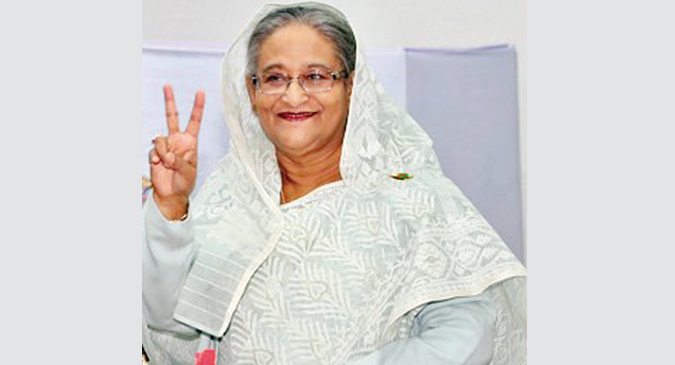
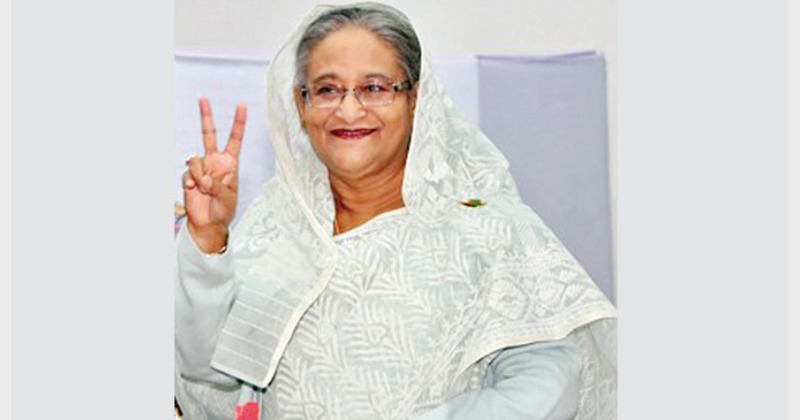
Bangladesh Prime Minister Sheikh Hasina flashes a victory sign
The 16 member coalition led by Sheikh Hasina garnered 288 seats of a 300 elected member parliament with 258 seats for AL single party with its partner Jatiya Party managing 20 seats. Even when AL was given a walkover in 2014, it received 234 seats with a lower percentage of support. Hasina won with a huge margin of 2,29,539 votes from the Goplaganj seat, allowing the BNP candidate S M Jilani 123 votes, Islami Andolan Bangladesh candidate Mohammed Maruf Sheikh 71 votes, and others only 14 votes. The opposition alliance that brought together Bangladesh Nationalist Party (BNP) and a Jatiya Oikya Front (United National) could scramble only six seats. As events unfolded in the months before these elections, it was evident the most significant factor that was going to work for AL was the lack of strong opposition. The opposition appeared weak and was unable to offer any cohesive alternative to the electorate.
Bangladesh has received effusive praise from the World Bank for lifting a substantial population out of abject poverty
Undoubtedly, there was much going in favour of Hasina’s leadership. Bangladesh is presently one of the fastest growing economies in Asia surpassing even China with a growth of 7.28 per cent in the past year with a robust GDP standing at US$250 billion. The trebling of its per capita income since Hasina took over in 2008 has been no mean achievement. While Bangladesh has maintained better human development indicators than its South Asian neighbours in the past decade, it also received effusive praise from the World Bank for lifting a substantial populationout of abject poverty. Bangladesh’s key export industry of readymade garments grossed over the US $30 billion making it globally the second-largest after China. The last ten years saw a spurt in infrastructure including rapid growth in its energy sector. Significantly Bangladesh’s transition to a middle-income country was a remarkable turnaround from what was once termed as ‘a basket economy.’ But more importantly, Hasina’s empathy and compassion reflected over her adept handling of the 7,00,000 Rohingyas as they poured in through the borders fleeing persecution from the security forces in Myanmar, was admirable. Not only were the teeming population organise in camps in Cox bazaar area but Hasina stood her ground against any suggestion of non- voluntary return.
Bangladesh’s journey from 2008 to 2018 was one of growth and development. But then where was the occasion for self-doubt?
Bangladesh is no stranger to political manoeuvres. Its history has been replete with authoritarian rule, coups and counter-coups, manipulations and intrigues. Despite Bangladesh’s return to democracy in 1991 with the exception of a phase of fifteen years, it was once again plunged to another spell of political crises in 2006. The two netris (women leaders) Sheikh Hasina (AL) and Khaleda Zia (BNP) heading the two main political parties largely reflected the broad political divide in Bangladesh. And till 2008 when Sheikh Hasina was ushered in with one of the largest majority in recent years, the anti-incumbency factor seemed to be at play. The past polling behaviour suggests that both the netris are able to win over one-third of the electorate and final verdict usually lay with the other, one third swing factor.
The genesis of the present political crises can be traced to the adoption of the June 2011 Constitution 15th Amendment Bill, entirely abolishing the Caretaker Government (CG) system as established under the 13th Amendment. Interestingly, the Supreme Court had also provided for the system to remain in practice for the next two JS elections for the sake of ‘safety of the state and its people’. When AL Government decided to go ahead with 2014 election without the CG system, the opposition led by BNP chose to boycott the polls on the ground that free and fair multiparty election was not possible without the CG system in operation. With a walkover of 153 seats, the ruling AL secured an overwhelming majority of over 230 seats. Not surprisingly, Bangladesh which usually witnesses huge voters turn out reaching a high of 87 per cent during the 2008 elections, could barely muster 25 per cent voters turnout.
This time round the government was not going to leave anything to chance. BNP had to be diluted; Khaleda languished in prison facing 22 cases of corruption, with the heir apparent Tarique Rahman banished to London under similar corruption charges. Political obduracy did not allow for propping up of any alternate leadership so while the victim card had outlived itself, Khaleda would yet not concede the space. Inevitably, the leaderless and rudderless BNP’s manifesto was all about scrapping ‘black laws’ and improving law enforcement measures. The election promises were more fury than substance, without a serious choice of governance and its insistence to cohabit with the Jamaat boomeranged. The war criminal trial had a universal appeal, and Jamaat’s political presence was reprehensible for most including the first generation voters.
The Unity Front led by Kamal Hossain was seen as last-minute fledging effort without much popular appeal. Its manifesto that centred on righting the wrong of the present government may have had some appeal, but it did not cover a large canvas. The opposition till the last weeks focussed on dialogue with the government and missed the opportunity to portray a consolidated front as a reliable alternative. Series of political developments in Bangladesh revealed Hasina authoritarian ways. While specific terror attacks saw a series of hard measures for removing militants, Islamic offenders attacking secularists were allowed to slink away. Awami not only pandered this constituency but also associated Hefazat-e-Islam a strident Islamic grouping. But her intolerance towards any view that was not indifferent from her was harsh. The media repression was strong and reflecting a closed system, not a contemporary democracy. Recent incidents concerning students further pointed towards this attitude.
For India, AL in Dhaka has always worked in its favour. The present ties are the best that the two neighbours have ever enjoyed. Undoubtedly, Bangladesh is a crucial partner in India’s regional journey. India’s choices in Dhaka are limited and given BJP’s domestic mantra, India is treading on thin ice. While Hasina has glossed over India’s NRC issue and its fence-sitting over the question of Rohingya it has not been lost on Bangladeshis. Interestingly, the anti-India rhetoric during the recent election campaign was missing perhaps resonating a growing understanding of India’s contribution to Bangladesh’s development trajectory. Also while the opposition has tried to explain a change in policy towards India, but doubts linger.
In the short term, this development works for India. The long-term implication for such one-sided elections spells disaster. Bilateral relations go beyond leadership, the state to state and people to people ties need strengthening. India must not miss the big picture.
(The writer is senior fellow at Vivekananda International Foundation and former Director, Maulana Abul Kalam Azad Institute of Asian Studies, Kolkata )