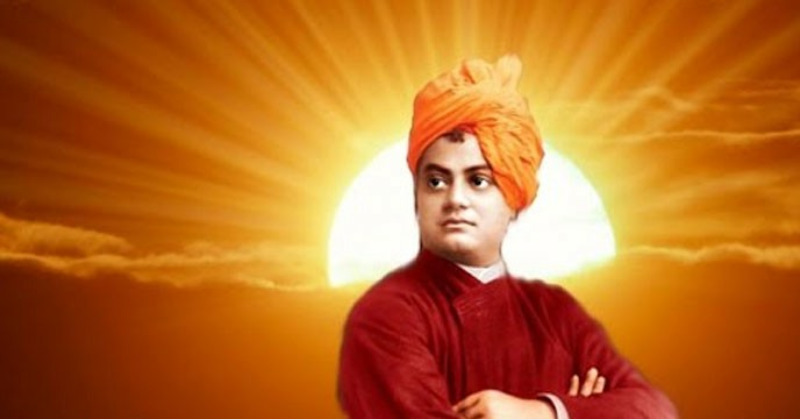
Swami Vivekananda spoke about religion, rituals, caste and the education of the masses in an interview he gave The Hindu on February 6, 1897, during a train journey from Chingleput to Madras.
1. What made you to go to America, Swamiji?
Rather a serious question to answer in brief. I can only answer it partly now. Because I travelled all over India, I wanted to go over to other countries. I went to America by the Far East.
2. What did you see in Japan, and is there any chance of India following in the progressive steps of Japan?
None whatever, until all the three hundred millions of India combine together as a whole nation. The world has never seen such a patriotic and artistic race as the Japanese, and one special feature about them is this, that while in Europe and elsewhere Art generally goes with dirt. Japanese Art is Art plus absolute cleanliness. I would wish that every one of our young men could visit Japan once at least in his lifetime.Is it your wish that India should become like Japan?
Decidedly not, India should continue to be what she is. How could India ever become like Japan, or any nation for the matter of that? In each nation, as in music, there is a main note, a central theme, upon which all others turn. Each nation has a theme: everything else is secondary. India’s theme is religion; social reform and everything else are secondary.
Therefore, India cannot be like Japan. It is said that when ‘the heart breaks,’ then the flow of thought comes. India’s heart must break and the flow of spirituality will come out. India is India. We are not like the Japanese, we are Hindus. India’s very atmosphere is soothing. I have been working incessantly here, and amidst this work I am getting rest. It is only from spiritual work that we can get rest in India. If your work is material here, you die of diabetes.
3. What is your idea about the results of the Parliament of Religions?
The Parliament of Religions, as it seems to me, was intended for a ‘heathen show’ before the world, but it turned out that the heathens had the upper hand, and made it a Christian show all around. So the Parliament of Religions was a failure from the Christian standpoint, seeing that the Roman Catholics, who were the organisers of that Parliament, are, when there is a talk of another Parliament at Paris now steadily opposing it. But the Chicago Parliament was a tremendous success for India and Indian thought. It helped on the tide of Vedanta, which is flooding the world. The American people — of course, minus the fanatical priests and churchwomen — are very glad of the results of the Parliament.
4. What prospects have you, Swamiji, for the spread of your mission in England?
There is every prospect. Before many years elapse, a vast majority of the English people will be Vedantins. There is a greater prospect of this in England than there is in America. You see, Americans make a fanfaronade of everything, which is not the case with Englishmen. Even Christians cannot understand their New Testament, without understanding the Vedanta. The Vedanta is the rationale of all religions. Without the Vedanta every religion is superstition, with it everything becomes religion.
5. What are your views with regard to the Indian masses?
Oh, we are awfully poor, and our masses are very ignorant about secular things. Our masses are very good because poverty here is not a crime. Our masses are not violent. Many times I was near being mobbed in America and England, only on account of my dress. But I never heard of such a thing in India as a man being mobbed because of peculiar dress. In every other respect, our masses are much more civilised than the European masses.
What will you propose for the improvement of our masses? We have to give them secular education. We have to follow the plan laid down by our ancestors, that is, to bring all the ideals slowly down among the masses. Raise them slowly up, raise them to equality. Impart even secular knowledge through religion.
6. But do you think, Swamiji, it is a task that can be easily accomplished?
It will, of course, have gradually to be worked out. But if there are enough self-sacrificing young fellows, who, I hope, will work with me, it can be done tomorrow. It all depends upon the zeal and the self-sacrifice brought to the task.
But if the present degraded condition is due to their past Karma, Swamiji, how do you propose to help them?
Karma is the eternal assertion of human freedom. If we can bring ourselves down by our Karma, surely it is in our power to raise ourselves by it. The masses, besides, have not brought themselves down altogether by their own Karma. So we should give them better environments to work in. I do not propose any levelling of castes. Caste is a very good thing. Caste is the plan we want to follow. What caste really is, not one in a million understands. There is no country in the world without caste. In India, from caste we reach to the point where there is no caste. Caste is based throughout on that principle. The plan in India is to make everybody Brahmana, the Brahmana being the ideal of humanity. If you read the history of India you will find that attempts have always been made to raise the lower classes. Many are the classes that have been raised. Many more will follow till the whole will become Brahmana. That is the plan. We have only to raise them without bringing down anybody. And this has mostly to be done by the Brahmanas themselves…
7. What are your views, Swamiji, in regard to the relation of caste to rituals?
Caste is continually changing, rituals are continually changing — so are forms. It is the substance, the principle, that does not change. It is in the Vedas that we have to study our religion. With the exception of the Vedas, every book must change. The authority of the Vedas is for all time to come; the authority of every one of our other books is for the time being.
For instance, one Smriti is powerful for one age, another for another age. Great prophets are always coming and pointing the way to work. Some prophets worked for the lower classes, others like Madhava gave to women the right to study the Vedas. Caste should not go, but should only be readjusted occasionally. Within the old structure is to be found life enough for the building of two hundred thousand new ones. It is sheer nonsense to desire the abolition of caste. The new method is evolution of the old.
Instead of frittering away our energies on ideal reforms, which will never become practical, we had better go to the root of the evil and make a legislative body, that is to say, educate our people, so that they may be able to solve their own problems. Until that is done, all these ideal reforms will remain ideals only.
8. Do you think Hindu society can successfully adopt European social laws?
No, not wholly. I would say, the combination of the Greek mind represented by the external European energy added to the Hindu spirituality would be an ideal society for India. For instance, it is absolutely necessary for you. Instead of frittering away your energy and often talking of ideal nonsense, to learn from the Englishman the idea of prompt obedience to leaders, the absence of jealousy, the indomitable perseverance and undying faith in himself.
9. What relation, Swamiji, does ritual bear to religion?
Rituals are the kindergarten of religion. They are absolutely necessary for the world as it is now; only we shall have to give people newer and fresh rituals. A party of thinkers must undertake to do this. Old rituals must be rejected and new ones substituted.
10. Then you advocate the abolition of rituals, don’t you?
No, my watchword is construction, not destruction. Out of the existing rituals, new ones will have to be evolved. There is infinite power of development in everything: that is my belief. One atom has the power of the whole universe at its back. All along, in the history of the Hindu race, there never was any attempt at destruction, only construction. One sect wanted to destroy, and they were thrown out of India. Shankara, Ramanuja, Madhava and Chaitanya. They were great reformers, who always were constructive, and built according to the circumstances of their time. This is our peculiar method of work. All the modern reformers take to European destructive reformation, which will never do good to anyone and never did…
… The progress of the Hindu race has been towards the realisation of the Vedantic ideals. All history of Indian life is the struggle for the realisation of the ideal of the Vedanta through good or bad fortune. Whenever there was any reforming sect or religion which rejected the Vedantic ideal, it was smashed into nothing.
(Reproduced from ‘The Complete Works of Swami Vivekananda- Volume 5)